Roadside incidents without clear evidence leave fleet managers guessing. Without proof, false claims happen, insurance claims drag on, and an entire fleet operation suffers.
Dash cams change that and are one of the most important devices in any fleet management system. They capture footage of what happened, when, and where. Fleets get protection against false claims, faster insurance resolution, and clear visibility into driver performance.
Key takeaways
- A dash cam is a camera that continuously records video footage of a vehicle’s journey, capturing what happens on the road and inside the cabin to create a complete record of driving events.
- Dash cams work by recording footage triggered either continuously or by detected incidents such as harsh braking or collisions.
- There are several types of dash cams available, including forward-facing, rear-facing, dual-facing, and interior cameras, each designed to meet to different monitoring needs.
- Key features to look for include video resolution, GPS tracking, audio recording, parking mode, and AI-powered driver alerts.
- Fleet management operations benefit most from dash cams that combine incident recording, real-time alerts, and cloud connectivity, giving managers clear visibility into driver behaviour and on-road events.
What is a dash cam?
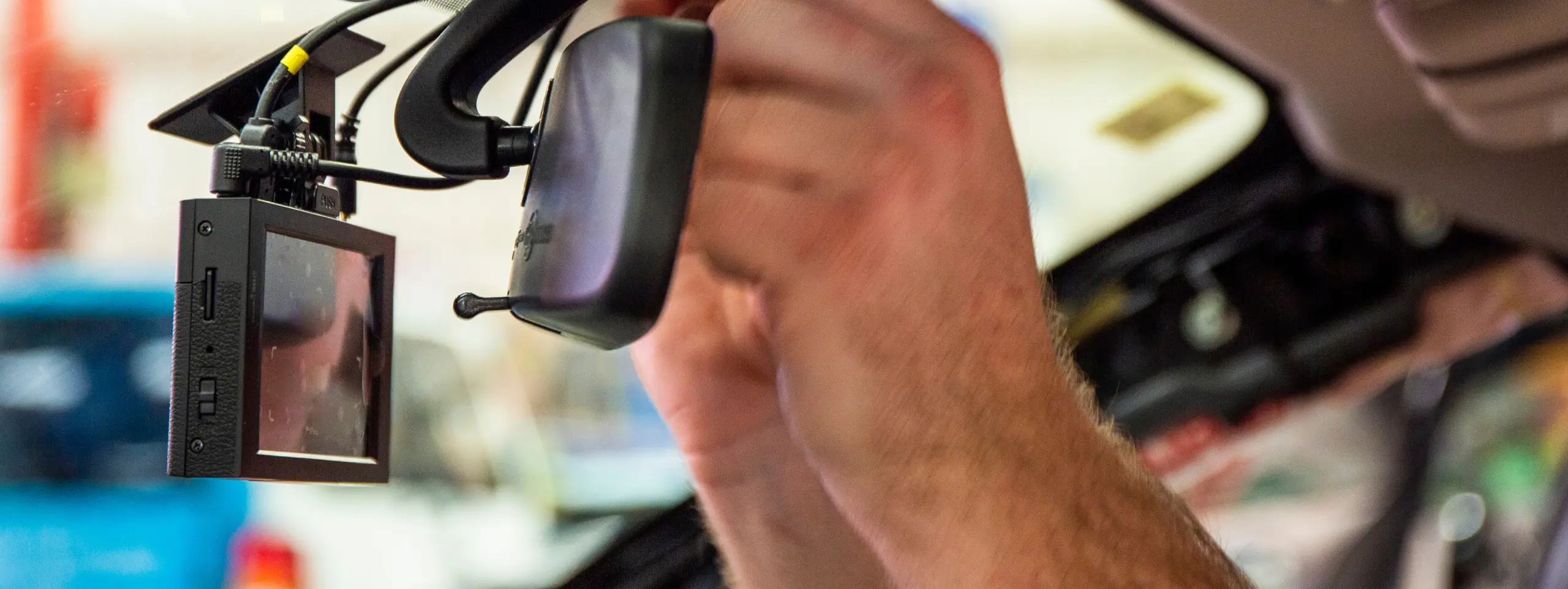
A dash cam is a camera that records video footage of a vehicle’s journey. It continuously captures what’s happening on the road and/or inside the vehicle to create a complete record of driving events.
Most modern fleet dash cams capture:
- Video and audio of the journey
- GPS data that tags location and speed information to the footage
- Timestamped incident recordings with exact location, time, and vehicle speed attached
Most fleet dash cams are cloud-connected, which means footage is automatically uploaded and stored securely. This is different from consumer dash cams, which are often saved to an SD card.
With cloud storage, you can access incidents remotely, share footage quickly for insurance claims, and keep a permanent record without worrying about physical storage limits.
How do dash cams work?
A dash cam uses a lens and an image sensor to capture video footage of the road in front of, behind, or inside the vehicle, depending on the camera type.
Most fleet dash cams connect to a vehicle’s power supply and switch on automatically when the engine starts. Footage is then either captured continuously or, more commonly, captured only when an incident occurs. Recordings will also show GPS data, speed, and timestamps.
Nowadays, many dash cams use AI to detect risky driver behaviours as they happen, triggering in-cab alerts to prompt an immediate correction. The camera also communicates with fleet management software, meaning managers can review footage, monitor driver behaviour, and respond to incidents as needed.
How do dash cams record video and audio?
Dash cams are equipped with different recording modes:
- Continuous recording: The camera records continuously. This creates a continuous loop. Once the storage is full, older footage is overwritten with new footage. Continuous recording provides complete coverage of everything that happens during a shift, which is useful for reviewing driver behaviour or road conditions over time.
- Incident-based recording: These cameras start recording only when they detect an incident, such as a collision, harsh braking, or sudden acceleration. This saves fleet managers from needing to scroll through hours of footage just to find a single incident.
- Audio recordings: Some dash cams also capture and record audio, which adds important context to footage. In the event of an incident, audio can help clarify whether it involved road rage, communication between occupants, or external, distracting sounds.
How are dash cams powered?
Depending on the type of cameras used, dash cams can be powered in different ways:
- Hardwired: Most fleet dash cams are hardwired directly into a vehicle’s electrical system. This means they draw power from the battery or fuse box and typically turn on and off automatically with the vehicle. This way, you don’t have to worry about charging or battery life. The footage continues to record as long as the vehicle is running.
- Battery-powered: Some dash cams run on internal batteries. These are easier to install since they require no wiring, but they do need regular charging. Battery-powered cameras are less common in commercial fleet operations because they require more maintenance and can run out of battery at inconvenient times.
How does a dash cam work when the car is off?
In most cases, a dash cam stops recording when the vehicle is switched off. Fleet dash cams are powered through the vehicle itself, so when the engine stops and power is cut, the camera stops too.
For most fleets, the priority is capturing clear, reliable footage during active journeys. Recording is enabled when the vehicle is switched on and stops when it is switched off, creating an accurate record of every trip without unnecessary overhead.
Types of dash cam
Dash cams come in different models depending on what you need to monitor:
1. Forward-facing dash cams
Front dash cams are standard forward-facing cameras that record the road ahead. They capture what’s happening in front of a vehicle, recording incidents such as collisions, road hazards, and other vehicles involved.
2. Rear dash cams
Rear dash cams mount on the back of a vehicle and record what’s behind the vehicle. They’re particularly useful for catching incidents where another vehicle hits from behind, or for monitoring tailgating and unsafe driving behaviour from other vehicles.
3. Dual-facing dash cams
Dual-facing dash cams combine a forward and rear camera in one system, giving you complete visibility of incidents in front of or behind your vehicle. They’re ideal if you want comprehensive coverage without installing multiple cameras.
4. Interior dash cams
Interior dash cams face into the cabin and record driver behaviour, such as distractions and drowsiness, and can confirm whether a driver is wearing their seatbelt. They’re useful for understanding how drivers are operating. Some operations use interior cameras alongside external cameras to capture a complete picture of what’s happening inside and outside the vehicle.
Are dash cams worth it?
For fleet managers, dash cams are among the most essential investments. Moreover, they are increasingly becoming required by insurance companies.
With access to incident footage, insurance claims are more likely to be resolved faster and more fairly. Clear, timestamped video gives insurers the evidence they need to make informed decisions quickly. That same footage can also exonerate drivers when incidents are not their fault, protecting both their professional record and your operation’s reputation.
Dash cams also help drivers stay safer on the roads, reducing risk across your entire fleet. By proactively addressing unsafe driving behaviours, fleet managers can offer targeted coaching and training that can also lower insurance premiums over time.
Benefits of using dash cams in fleet management
The biggest reason for any fleet manager to use dash cams is safety. However, increasingly, insurance companies are requiring that telematic solutions, such as dash cams, be installed in fleets.
With this in mind, there are some key benefits that any fleet manager should be aware of:
1. Improve driver behaviour
Dash cams capture specific bad driving habits, like harsh braking, distracted driving, and speeding. Instead of waiting for an accident to happen, you can identify these patterns early and address them directly.
This becomes especially helpful when dash cams are paired with custom dashboards that show which driver behaviour patterns need to be addressed.
If your data shows that specific improper driving behaviours are recurring across multiple drivers, you can create training modules to address them. If these driving patterns might reveal a different picture. For example, if harsh braking is common on specific routes, you can investigate the causes and tailor your approach accordingly.
2. Speed up insurance claims
When an accident happens, the claims process can be slow and complicated. Without clear evidence, fleets can end up bearing costs or liability even when drivers weren’t at fault.
Dash cam footage provides timestamped evidence of exactly what happened. Insurance companies can review the footage and make informed decisions more quickly.
This also protects drivers. If someone wrongly blames a driver for an accident, dash cam footage can prove the driver’s innocence. It protects the driver’s professional record and removes the stress from unfair accusations.
3. Enhance driver safety
Modern dash cams are equipped with AI capabilities. These cameras detect risky actions like yawning, lane drifting, or mobile use. When the AI spots a potential safety issue, it triggers an in-cab alert for drivers to correct their behaviour.
These in-cab alerts happen as soon as the risky behaviour is detected, so drivers can correct course before an incident occurs. If a driver drifts out of their lane, an alert prompts them to steer back into their lane. If they show signs of fatigue, the system warns them to take a break.
Are dash cams legal in fleet management?
In the UK, fleet dash cams are legal. However, fleet managers are still required to ensure dash cam use complies with UK law.
Under the Highway Code and The Road Vehicles (Construction and Use) Regulations 1986, a dash cam must not intrude more than 40mm into the area of the windscreen swept by the wipers.
Any footage that captures drivers is considered personal information under UK GDPR. This means fleet managers have a legal responsibility to handle that data responsibly. It also means that operations need a lawful basis for processing recordings. For most fleets, this falls under legitimate interest, covering purposes such as driver safety, fraud prevention, and asset protection. That justification should be clearly documented in a written dash cam policy.
Most importantly, drivers must be informed that cameras are in use. This applies to both forward-facing and interior cameras. Recording without informing drivers can constitute a GDPR breach, regardless of whether the footage is ever shared.
How to choose a dash cam: key features to look for
With a wide range of dash cams on the market, it can be difficult to know where to start. Here are some features that matter most for fleet operation:
Video resolution
Resolution determines how much detail is captured in recordings. Many fleets opt for high-resolution cameras that record in 1080p full HD. This makes it easier to read number plates, identify road signs, and pick out important details in the event of an incident.
Audio recording
Audio capability adds important context to video footage. In the event of an incident, being able to hear what was happening inside the cab alongside what the camera captured can have a significant impact on how to respond internally.
AI driver alerts
Dash cams with AI can detect risky behaviours in real-time, including lane drifting, mobile phone use, harsh braking, and signs of driver fatigue. When the system detects an issue, it triggers an in-cab alert to prompt an immediate correction.
Field of view
The lens angle determines how much of the road the camera captures. A wider field of view reduces blind spots and gives more complete coverage of the surrounding environment. For larger vehicles or those operating in busy urban areas, a wider lens angle reduces the risk of missing important details at the edges of the frame.
Equip your fleet with dash cams with Matrix iQ
Whether the goal is to improve driver safety, speed up insurance claims, or get a clearer picture of what’s happening on routes, dash cam footage provides the evidence needed to make informed decisions.
Make sure to get in touch with our team to see how you can improve your fleet operations.